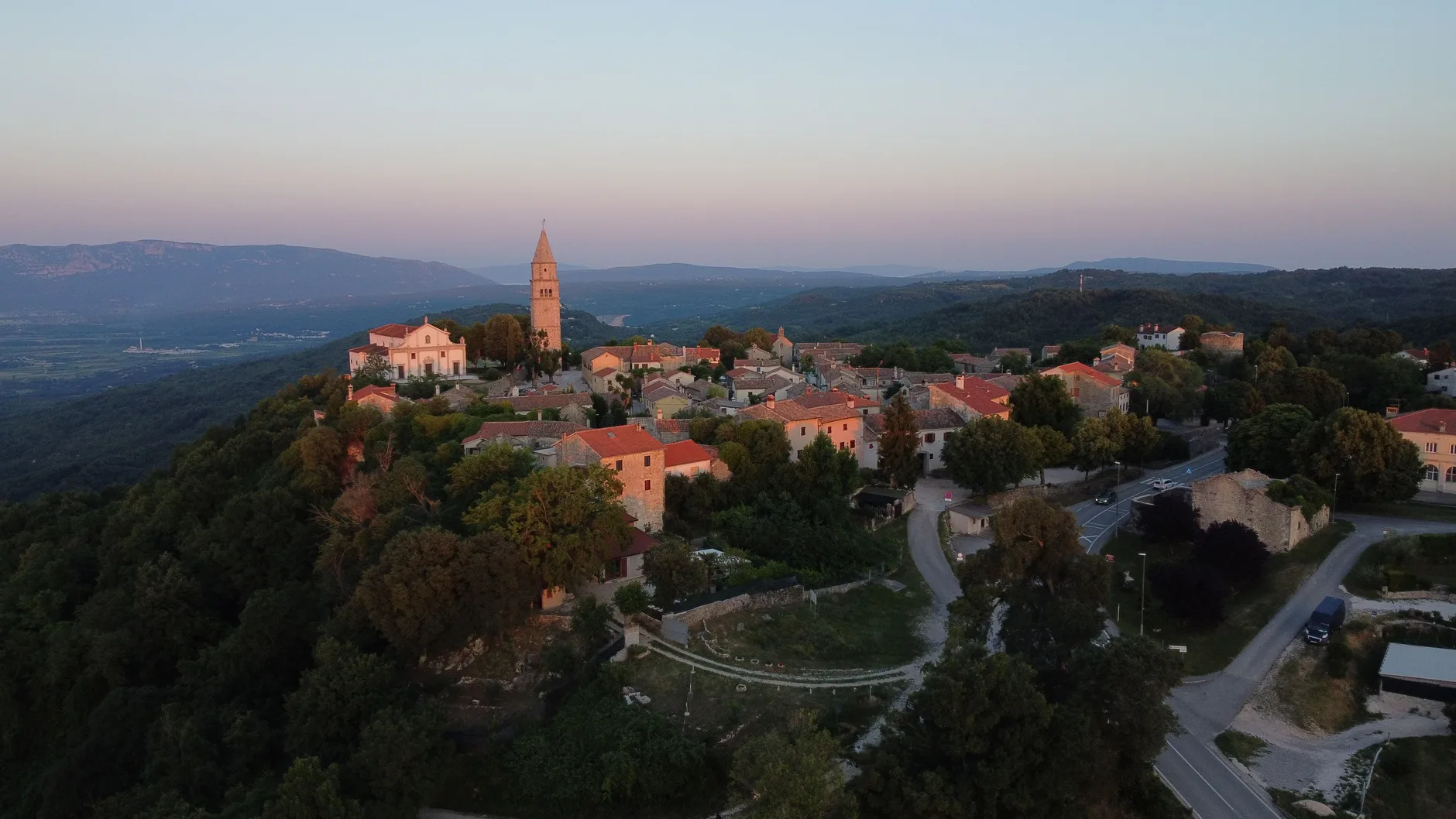
Which roads link Pula with the rest of Istria?
For driving in Istria the main road is the Istrian Y, 141 km of motorway in two arms: the A9 runs 77 km from the Slovenian border area at Plovanija, near Umag, down the west of the peninsula to Pula, and the A8 runs 66 km from the Rovinj junction at Kanfanar through Pazin and Lupoglav to Matulji above Rijeka. Bina Istra, founded in 1995, holds the concession to 15 December 2041. The drive from the terminal, where you pick up a hire car at Pula Airport, joins the A9 at the Pula plaza about 4 km on.
Off the motorway, the D401 runs 1.5 km from the airport to the D66 at Valtura, and the D75 follows the west coast through Bale, Poreč and Umag. The table gives the drive times from the airport; the 41 km from Pula to Rovinj by car follow the A9 north and then the D75 towards Bale. Times are without traffic or stops; summer queues and toll plazas add to them. A rental car may travel on paved public roads alone (clause 8), so keep to them.
| To | Road km | Drive time |
|---|---|---|
| Medulin | 14 km | 25 min |
| Rovinj | 41 km | 55 min |
| Poreč | 58 km | 1 h 00 |
| Opatija | 99 km | 1 h 30 |
| Rijeka | 106 km | 1 h 35 |
How do I pay tolls on the Istrian Y?
Croatian motorways are paid at toll plazas rather than by vignette. On the Istrian Y you pay at the plaza in cash, by bank card or INA card, or with an ENC tag; check the vehicle class and the amount on the lane screen before paying. An ENC tag from the other Croatian motorways needs Bina Istra’s encoding to work here, so plan to pay at the plaza. Tolls are the renter’s cost (clause 12).
The A8 crosses Učka mountain in the tolled Učka tunnel, whose second tube, 5,630 m long, opened on 13 September 2024. The new barrier-free system, Crolibertas, is planned to apply in full from 1 March 2027, with 22 gantries on the A8 and 23 on the A9, reading an ENC tag or the number plate. On 25 September 2026 works were under way on the last section, between the Učka tunnel and Matulji, with two-way traffic on a narrowed carriageway and possible short stoppages; HAK’s road report, on 072 777 777, has the day’s conditions before a long drive.
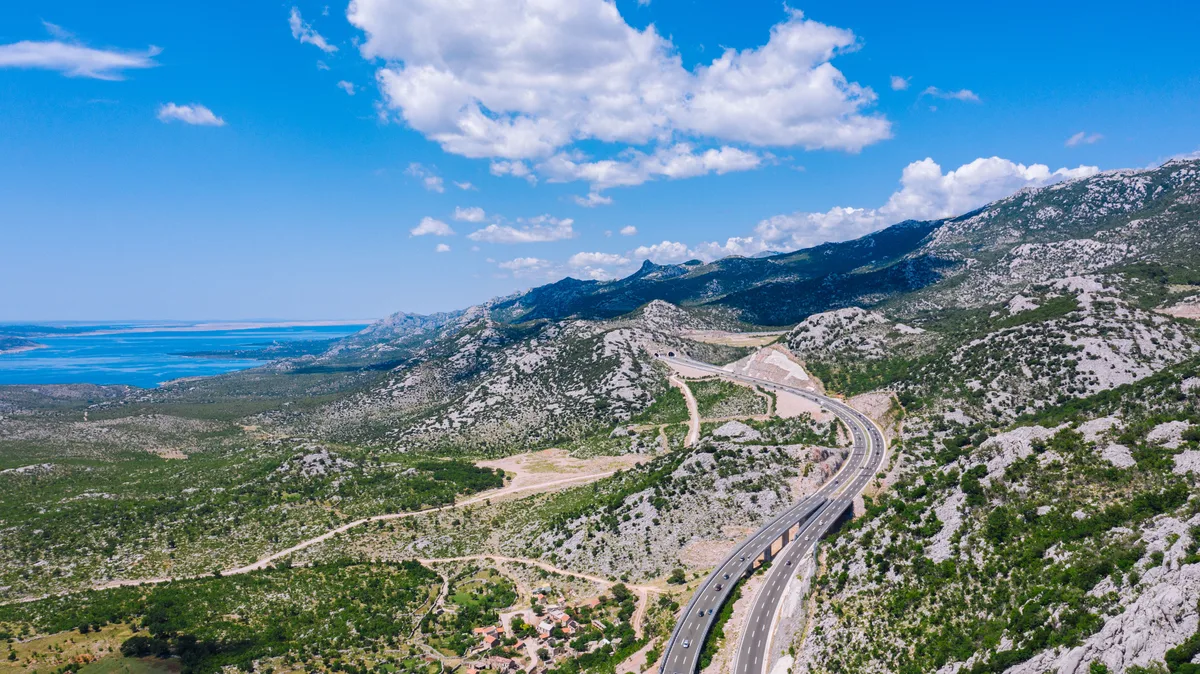
Search cars at Pula Airport
Search carsWhat are the speed limits and main rules in Istria?
Croatian law sets 50 km/h in built-up areas, where a sign may allow up to 80 km/h, 130 km/h on motorways, 110 km/h on expressways and 90 km/h on other roads, and signs override the defaults. Young and newly qualified drivers follow the same limits: their separate limit was abolished in 2017, and the remaining young-driver rules, a zero alcohol limit among them, cover drivers under 24 with a Croatian licence. For an ordinary car driver the alcohol limit is 0.5 per mille.
Phones at the wheel are hands-free, and every seat with a belt needs it worn, front and back. Dipped headlights or daytime running lights are compulsory in daylight from 1 November to 31 March, and dipped headlights in every tunnel all year; inside a tunnel, keep moving, since stopping, parking, reversing and turning are banned. From 15 November to 15 April winter equipment is compulsory on the designated winter sections: four winter tyres, or summer tyres with at least 4 mm of tread plus chains for the driven wheels.
| Offence | Fine |
|---|---|
| Holding a phone while driving | 130 |
| Seat belt not worn, driver or passenger | 130 |
| Child under 150 cm not carried as the child-seat rule requires | 130 |
| No dipped or daytime running lights by day, 1 November to 31 March | 30 |
| No dipped lights in a tunnel | 60 |
| Stopping, parking, reversing or turning in a tunnel | 130 to 260 |
What are the rules for children in the car?
They go by height. A child under 150 cm travels in a child seat or booster held by the car’s belt or anchor points; a child between 135 and 150 cm may use the adult belt instead, on a seat other than a front seat. A rear-facing child seat goes in the back, or in front with the passenger airbag switched off. Every car must also carry a warning triangle, a first-aid kit and a reflective vest, which the driver wears when working beside the car on the road.
Which driving licence do I need in Istria?
The law lets you drive on a licence from any European Economic Area country; a licence from outside it, a UK licence included, is accepted on the basis of reciprocity, and an international driving permit counts when the issuing country’s authority issued it. The rental adds its own rule: the original national licence with its details in Latin script, valid to the last day of the hire, rather than a copy or an electronic licence, with an international driving permit strongly recommended where your licence is valid in the issuing country alone (clause 14). The minimum age and driving experience are set per car (clause 13).
How does parking work in Pula and Rovinj?
Both towns zone their parking by colour, and the colours mean different things. In Pula, blue marks Zone 0, the old-town core, reserved for residents and local businesses; Zone 1 is red, with a 2-hour maximum stay, and Zone 2 yellow. A Pula ticket has to be paid within 10 minutes of parking. In Rovinj, blue is Zone 3, an ordinary paid zone, and Zone 1 is red with a 180-minute maximum.
Rovinj’s text-message payment is for Croatian networks. Both towns take payment at the meter, by QR code or in an app: Paydo or Aircash in Pula, Bmove or Aircash in Rovinj. Both old towns have pedestrian zones closed by bollards or barriers; park outside and walk in.
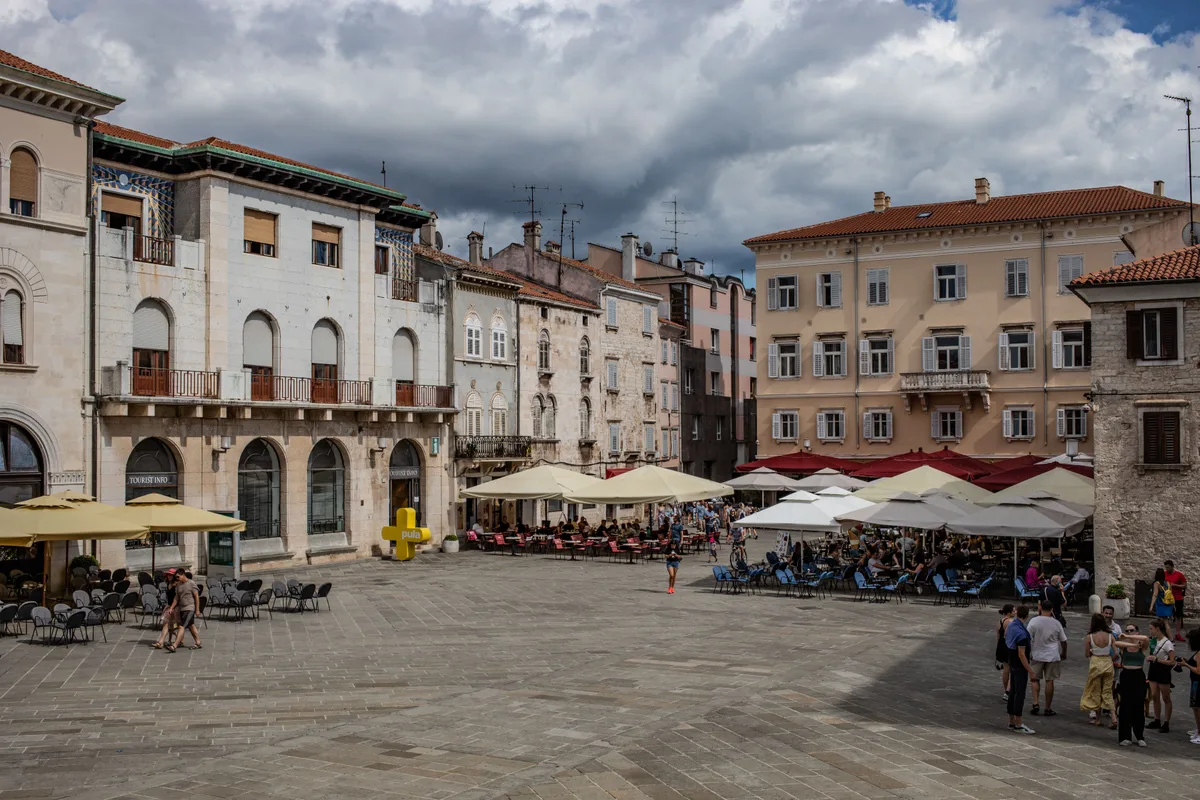
What if I drive beyond Istria?
East of the peninsula, the A8 meets the A7 above Rijeka, and the A7 round the city, the A6 inland to the Bosiljevo 2 junction and the A1 carry on to Zagreb and Dalmatia on motorways run by Hrvatske autoceste. There you take a ticket at the entry plaza and pay by distance at the exit, in cash in euros, by Diners, Mastercard, Maestro, Visa, INA or MOL card, or by ENC device; a missing entry record costs double the toll for the longest route on that motorway. A car collected in Pula can be returned in Zagreb, Zadar, Split or Dubrovnik on a one-way rental from Pula, with the one-way charge inside the price each car shows.
Slovenia and Italy are close: Trieste is 117 km from Pula Airport. Leaving Croatia needs permission: the cross-border option added during booking, for a fee, and the conditions arranged with the help desk by email (clause 9), and the 283 km from Pula to Venice by car cross the Slovenian coast on roads that are vignette-free in 2026. In a breakdown or accident, call the number on your rental voucher first: for an insured event the rental agent must be told at once and a police report obtained, unless the agent agrees otherwise, or the insurance issued for the car is cancelled (clause 6). HAK, the Croatian automobile club, runs a 24-hour breakdown service on +385 1 1987.